Some conversations don’t belong across a desk or meeting table.
They resist the structure of offices, video calls, and carefully scheduled meetings. They feel too compressed there, as though the question itself cannot quite stretch out enough to reveal its true shape. These are usually not technical conversations. They are conversations about direction.
A founder wondering whether the organisation they built still reflects the person they have become.
A leader sensing that the next decision carries consequences that spreadsheets cannot resolve.
A creative person recognising that the work that once felt alive now feels strangely mechanical.
In these moments, the difficulty is rarely a lack of intelligence. Nor is it a shortage of advice.
More often, it is a lack of space.
Modern professional life is extraordinarily good at generating analysis. We are surrounded by tools, models, and frameworks designed to accelerate thinking and sharpen decisions. But acceleration is not always what thinking requires. Some questions require distance before they reveal their true shape. Some decisions need time before they settle into place. And some conversations need a landscape.
Walking introduces a different kind of attention
When two people sit across from one another, the interaction becomes the centre of focus. Words carry weight. Silence feels conspicuous. The conversation tends to move quickly toward explanation, solution, or conclusion. Walking changes this rhythm.
Movement softens the intensity of direct interaction. Attention widens. Silence becomes natural rather than awkward. Thoughts emerge more slowly, often arriving from the edges of awareness rather than being forced into the centre. The landscape itself begins to participate.
Horizon, weather, terrain, and distance subtly alter the way attention behaves. Questions that felt urgent begin to loosen their grip. Others, previously unnoticed, quietly move into view. This is not romanticism. It is simply how human perception works.
For most of human history, thinking did not occur in enclosed rooms. It unfolded while moving through landscapes that continually reshaped attention – forests, hillsides, coastlines, open paths. The mind evolved in dialogue with landscapes. When we remove the landscape, thinking becomes narrower without us noticing. When we return to it, something subtle happens: thought regains proportion.
This is why mentoring outdoors can feel fundamentally different from mentoring in conventional settings. At its best, mentoring is not about advice. It is about companionship in inquiry – one person walking alongside another who is exploring something significant in their life or work. Experience is shared. Questions are explored. Perspective emerges through dialogue rather than instruction. The mentor’s role is not to provide answers but to help the other person see more clearly what they already know.
Landscape strengthens this process.
Because when attention widens, perception changes. When perception changes, so does understanding.
A decision that felt impossible may quietly resolve itself.
An ambition that once felt urgent may reveal itself as unnecessary.
A path that seemed obscure may suddenly appear obvious.
Not because someone provided the right technique, but because the environment allowed the thinking to reorganise itself.
Over the past few years I have been exploring this approach through what I refer to as Cognitive Rewilding — the idea that natural environments can restore the conditions in which clear perception and thoughtful decision-making emerge. More recently I have been deepening this work through mentoring traditions that emphasise reflective dialogue, experience-sharing, and learning through relationship.
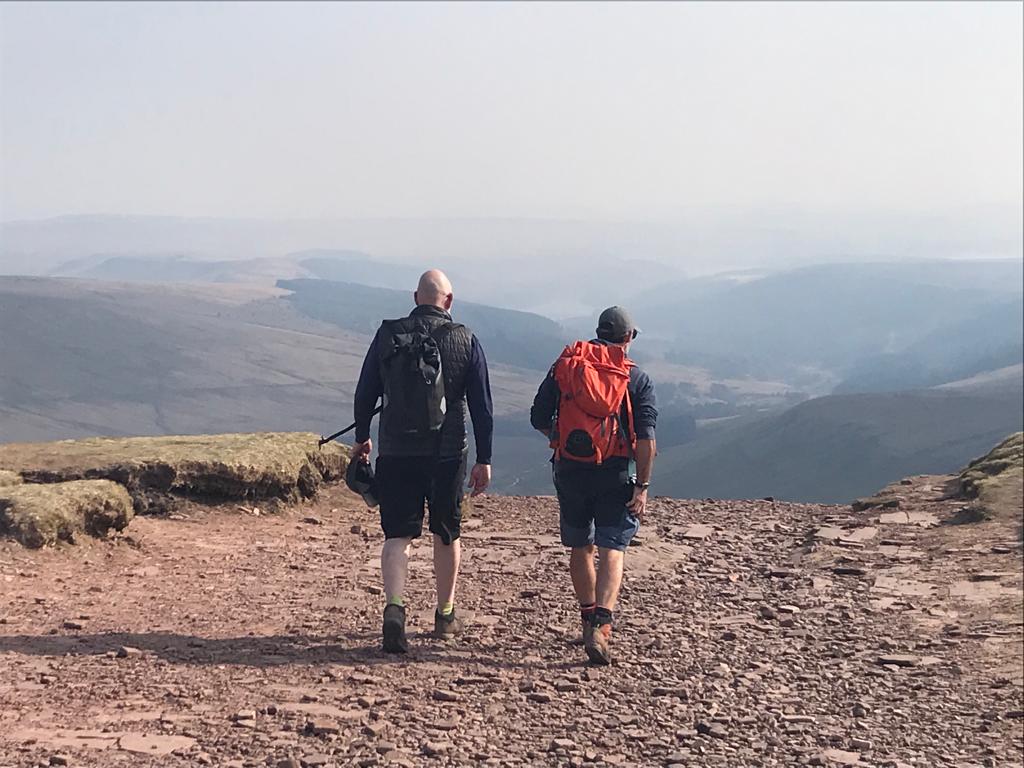
In practice, this often means walking with people through landscapes while they explore questions that matter to them – not as therapy or coaching, but as a structured conversation shaped by movement, time, and environment. The walk itself becomes the container.
Ideas surface and fade.
Stories are revisited.
Possibilities appear and disappear again.
Gradually, what once felt tangled begins to simplify. There is a quiet humility in this way of working. No one claims ownership of the insight that eventually arrives. The mentor does not manufacture it, and the landscape does not provide it. But together they create the conditions in which clarity can emerge. And when clarity arrives in this way, it rarely feels dramatic. More often it appears as a simple recognition – the sense that something has settled into place.
The next step becomes obvious.
In a world increasingly shaped by speed, abstraction, and constant attention, it is easy to forget that some forms of thinking require something older and slower.
Distance.
Movement.
Conversation that unfolds over time rather than demanding immediate resolution.
Sometimes the most valuable thing two people can do together is simply to walk. Because some conversations do not reveal themselves fully until the path begins to unfold beneath your feet.
This is the work I increasingly find myself doing with people — walking together while important questions are allowed the space they need to clarify.
Not rushing toward answers.
Simply creating the conditions in which they can appear.
 Garry Pratt | Outside Thinking